“An invisible red thread connects those who are destined to meet, regardless of time, place or circumstance. The thread may stretch or tangle, but will never break.” – Chinese Proverb.

Chinese: 姻緣紅線 Yīnyuán hóngxiàn; red thread of marriage Japanese: 運命の赤い糸 Unmei no akai ito; the red thread of fate // 結び の 神 – Musubi* no kami; matchmaking, love and marriage.
Though there are multiple versions of the Red String of Fate tale, the more popular and well known version involves a young boy who, walking home one night, sees an old man standing beneath the moonlight. The man is Yue Xia Laoren, the old lunar matchmaker god, and he explains to the boy that he is attached to his destined wife by red thread and show him the young girl it will be. The boy being young and disinterest in marriage or having a wife picks up a rock and throws it at the girl before running away.
Many years later when the boy has grown into a man, his parents arrange a wedding for him. On the night of their betrothal, his wife waits for him in their bedroom with the traditional veil covering her face. Raising it, the man is delighted to find his wife is one of the great beauties of his village but wonders at the adornment she wears on one eyebrow. When asked about it, the woman responds that when she was a girl, a boy through a rock at her which left a scar on her eyebrow. He realises she was who he had thrown the rock at when he was a boy.
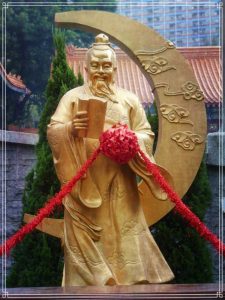
It is believed that there is a red cord attached to those that are destined to meet, and though it may twist and turn, tangle and stretch; it will never break and will ultimately bring two destined people together. In the original Chinese myth, the cord is fastened around the individual’s ankle. In Japan, it is bound from the male’s thumb to the female’s little finger; and in Korean culture, the red thread is thought to be fastened to the little finger of each party.
The red string of fate is a theme that turns up a lot within Eastern Asian literature and film, but also within the Western media and mythologies; though it is more commonly referred to as soulmates and twin flames.
While the stories they all tell are vastly different from the original folk tales, they all share the constant theme of two people finding each other no matter what. Even if they fall away from each other, or their lives twist and turn away from each other; they still find their way back to each other by the end. Oftentimes this is also after going through some form of personal transformation that makes the individual(s) better know themselves and understand others.


The Japanese animated film “Your Name” (君の名は, Kimi no No wa) tells the story of two characters, Mitsuha and Taki, who switch bodies when they fall asleep. At first they both think they’re just having a super realistic dream, then learn that those dreams are in actual fact real and that they are somehow switching bodies. They get to know each other by leaving messages and instructions to each other for when they wake up.
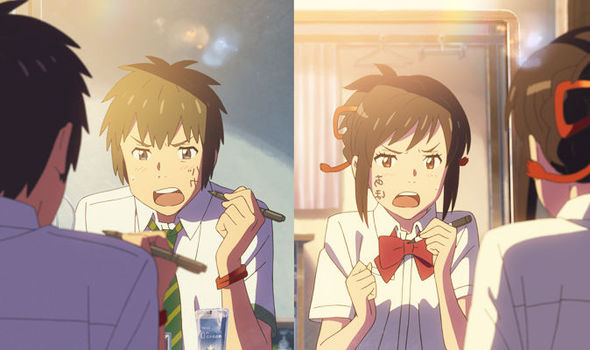
As the story progresses, they go in search for each other though it transpires their timelines are split three years apart from each other, so Taki doesn’t realise who Mitsuha is immediately when their paths first cross. Many years later, they are both living in Tokyo having forgotten the dreams they’d had, though they both have a sense of having lost something. They finally see and recognise each other again while on different trains that pass each other in a station which leads to them both getting off the trains and running across Tokyo trying to find the other.
“Musubi* is the old way of calling the local guardian god. This word has profound meaning. Tying thread is Musubi. Connecting people is Musubi. The flow of time is Musubi. These are all the god’s power. So the braided cords that we make are the god’s art and represent the flow of time itself. They converge and take shape. They twist, tangle, sometimes unravel, break, and then connect again. Musubi. Knotting. That’s time.”
Hitoha Miyamizu, Your Name
“Do you believe?
Even in a different time and a different dimension,
The one meant for you will appear and protect you.”
Xia Lin: Well Intended Love (Season 2)
In Well Intended Love (奈何BOSS要娶我, Nàihé BOSS yào qǔ wǒ), a relationship between the main characters Ling Yizhou and Xia Lin is initially instigated by a marriage contract. As the story progresses, the two fall in love with each other for real as they get to know each other. Even though Ling Yizhou loses his memory while hypnotised at one stage, the strength of the relationship brings his memories back through the strong, underlying bond the two share.
It is more into season two that the red string of fate concept appears with the characters living in an alternate timeline. While the storyline is different to the first season, it follows the characters as they find their destined partners. At the very end of the second season, Xia Lin is dreaming and sees flashes of the original story of how she and Yizhou came together and speculates that in every version of their lives, she and Yizhou would find each other some way.
The Korean drama It’s Okay Not to Be Okay (사이코지만 괜찮아, Saikojiman Gwaenchanh-a) which has just started on Netflix is a brilliant example of the dark and brooding side to the red string of fate and twin flames. A romance with a difference, it follows the healing journey of the two main characters and shows their emotional and psychological wounds in a profound manner.
Much like the original folk tales, It’s Okay Not to Be Okay shares flashbacks to the main characters as children when their paths first crossed. One is hurt and runs away and it isn’t until they’re adults that their paths finally re-unite.
A red string of fate relationship is one that is pre-destined and inexorable relationship that will occur at precisely the right moment. Whether the individuals are aware of each other or not, and no matter where their lives take them first, they will ultimately find their way to each other; and when they do finally come together, they will be in a place of understanding and balance which creates an unshakeable core to the relationship.
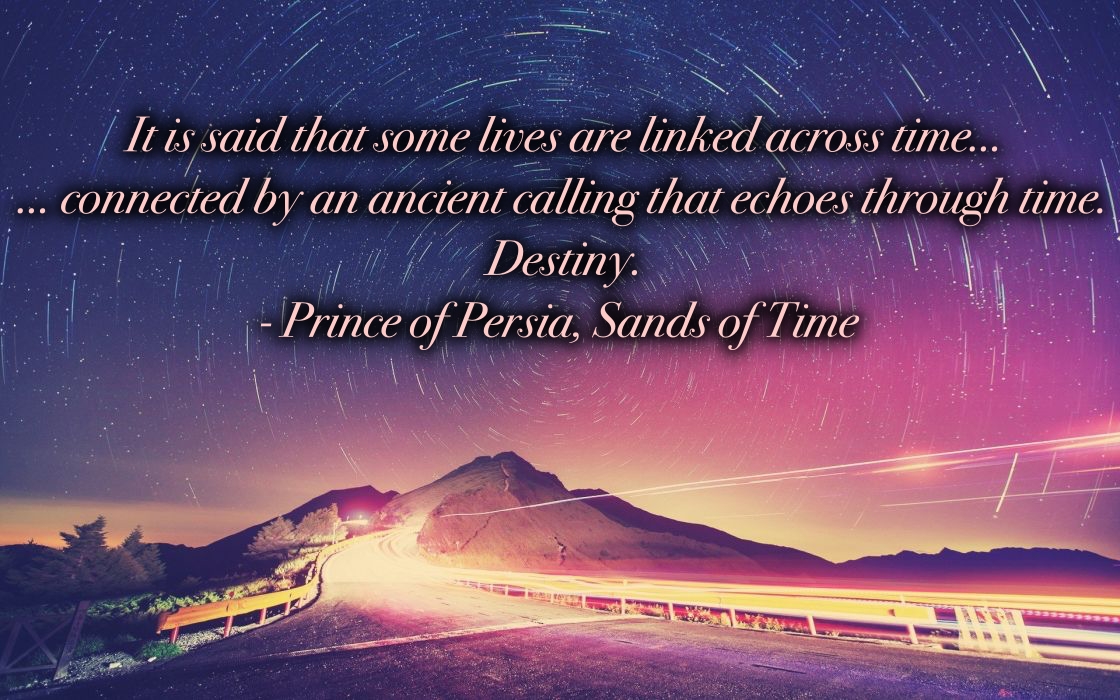
Twin flame relationships within the theory of the red string of fate eludes to a runner and a chaser – where one is more awake and aware of the connection while the other is either oblivious or freaked out by the intensity of the emotions. The roles can switch between partners throughout life, and there can be a lot of coming together and breaking a part as both deal with shadow work before a final union happens.
**Sadly because of the romanticisation of twin flame unions and soulmates, a lot of toxic and harmful relationships are over looked as “twin flame.” Shadow work refers to self improvement and self love, dealing with fears and past hurts and learning empathy and compassion to light up the darkness and become the epitome of yin and yang. It is important to know that any level of mental and/or physical abuse, the use gaslighting or any method for control and dominance is still an abusive relationship and anyone suffering from abuse needs help and support.

If you want to read more on Twin Flames, check out the post on ‘Twin Flames and False Flames’ here.

“And all along I believed, I would find you.
Time has brought your heart to me, I have loved you for a thousand years,
I’ll love you for a thousand more.”
Christina Perri – A Thousand Years
References:
The Taiwan Times. Find Love at Taiwan’s Top Five ‘Cupid Temples’. https://thetaiwantimes.com/find-love-at-taiwans-top-five-cupid-temples/
TV Tropes. Red String of Fate. https://tvtropes.org/pmwiki/pmwiki.php/Main/RedStringOfFate
Wikipedia. Read Thread of Fate. https://en.wikipedia.org/wiki/Red_thread_of_fate
Media Quotes:
Christina Perri. A Thousand Years.
Jo Yong. It’s Okay Not to Be Okay (사이코지만 괜찮아).
Jordan Mechner. Prince of Persia (Sands of Time).
Makoto Shinkai. Your Name (君の名は).
Qiang Wu. Well Intended Love (奈何BOSS要娶我).