Darkness. Ceaseless and reaching, it writhed and coiled upon itself. Over and around. Restless. Waiting. A speck of white jade answered the night, a seed that grew into an egg, its shell expanding throughout the night. The subtle luminance reached into the void and grew ever brighter.
Light entwined with darkness as the egg at last halted from its waxing and trembled in the twilight. A crack echoed through the void and the shell broke into two, the silver crescents forced apart by jadeite limbs that stretched from the light and the darkness quivered.
The light of silver and gold which had enveloped the egg drifted apart, becoming a dragon and a phoenix; manifestations of Yin and Yang. They circled together in dance before separating in a flash of golden claws and silver wings. The empyreal dragon soaring ever upwards from its twin, while the terrene phoenix begun its slow inclination.
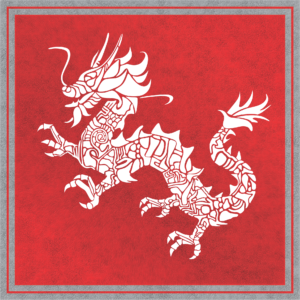
Pan Gu, the Coiled Antiquity, emerged from the fading light of the nexus; a colossal dragon made of jade with innumerable coils of nephrite. Letting the crescent shells drift into the ether, Pan Gu opened his eyes to the twilight, one of silver and one of gold.
The dragon and the phoenix had gone as far from each as they could bear, their bodies which had once been one yearned again for that completion of self. Pan Gu stretched out to them, a shimmering jade column spanning from silver to gold and connected the twins once more. He took the heart from each and switched them so that they would be connected evermore, and at last the twins settled; the dragon shifting into the firmament and the phoenix into the world. Pan Gu closed his eyes and let darkness ebb through the cosmos once more.
*
How long had it been? How long had he held down the land and raised up the sky? Roots had sprung from his talons and entwined deep into the ground while a crown of branches had grown from his horns to hold up the heavens. Crystalline folds chimed through the gloam as Pan Gu shucked off his jadeite skin and slithered free; a great tree which fixed the world and the sky in place remained. With the promise of immortality growing into peach blossom upon the tree, Pan Gu began to fade away; his essence giving life to the trinity he had forged with the dragon and the phoenix.
The perpetual flux of contrasting energies of yin and yang had brought wuxing into being, the five elements. Spirits emerged as starlit dew from the boughs of the tree. First wood, then water followed by metal. Earth came next, then finally fire. They slipped from the tree as serpentine flashes and skipped through the cosmos igniting each other as they came too close. They were the wuxing, born in disorder.
They were as chaotic as the primordial dark, clashing frenetically as the ground trembled and roiled and the sky flashed and howled. Cyan. Vermillion. Incarnadine. The quarrel fractured the twilight as the wuxing tore away from themselves, leaving incandescent trails throughout the sky.
Though far apart, the wuxing tormented each other. Their volatile energies brought discord back into being as they sparked and erupted, sending such commotion that the jade tree shuddered and sent the jewelled fruit towards the ground.
Pan Gu leapt into the expansive twilight; his body now more feline than serpent. From between his ivory fangs, a thunderous roar echoed endlessly and rattled the cosmos. The wuxing ceased their quarrel and were subdued by the fearsome voice.
Fire to water. Metal to earth. In a precise dance, Pan Gu moved slowly through a web of light of elements that sought pandemonium. Earth to fire. Wood to earth. The Coiled Antiquity moved carefully as he moved the unstable elements through dark paths. Wood to fire. He was cautious the wuxing wouldn’t cross each other so that they could become fixed in mutable harmony.
*
The cosmos brimmed and pulsed with energy as the boughs of the jade tree shifted in the wake of the wuxing. Pearled leaves tinkled softly in response with the promise of life. Pan Gu understood the song deep within his heart and set forth from the tree for the final time, down to the fertile silver mass of the phoenix.
The earth below was cube of secrets, her corners brushing softly against the circling heavens. As Pan Gu soared through the heavens with gold light warm upon his back and silver immanence below, his mind was overflowing with eighteen thousand dreams. The beads of sweat had gathered on Pan Gu’s body fell into the air below to form a sheer veil that drifted across the surface.
Trees of golden peach had formed a grove where the seeds of the jade tree had fallen during the wuxing’s wrath, and it was there that the Coiled Antiquity reached out his claws into the viscous ground and laid down his head at last. Silver and gold watched over the world as his body shimmered in black nephrite and diamond. His body that had once moved with such agility through the skies had petrified into five great mountains that spanned towards the heavens.
Letting out a slow breath, the four winds were born. To the east went the Azure Dragon of spring with a sprig from the jade tree clasped between its talons. The Vermillion Bird took flight and went south in a flutter of warmth from its fiery plumage. The rumbles of Pan Gu were still echoing through the heavens as the White Tiger went towards the west, the thunder captured in its throat as its fur shimmered pewter for a moment. Through a misty veil of water formed from the droplets of sweat, the Black Tortoise slowly made its way North, the beads glistening across its ebony shell. A yellow dragon was also born from that breath, the Quilin. It remained within the grove of sacred peach trees and watched the world unfold as peonies blossomed at its feet.
Rich fields and verdant forests came from the flesh of Pan Gu. His lifeblood emerged to the surface of the five mountains and cascaded in waterfalls of aquamarine and lapis to become rivers and lakes. His skeleton that was deep within the hardening earth shifted into myriad hues of rocks from which veins of metal begun to flow. Jade and pearl were created from his marrow and semen, the jewels gifted to the world by ocean and rock.
The world sang with so many different voices as the wind whispered through grasses and trees. Rains pattered softly on stone, and far away he could still hear the chimes of the jadeite tree marking time through space. The nephrite scales that had been a part of Pan Gu since he burst forth from the egg sparkled like stars upon the ground as he looked down at the world that he had become. The four winds circled around the sacred grove and lifted the scales, carrying them to the four corners. Zephyr fingers brushed over Pan Gu’s brow as his eyes closed to the world. The first night.
The left eye shone brighter still and begun to lift towards the firmament in Aurelian light. The right eye was softer, more secretive and subtle. It lingered behind the golden orb, transmuting the golden light of day into the silver of night. The scales which had been raised by the wind began their slow metamorphosis as the ink black sky faded into dawn. The sun begun its ascent from the Eastern horizon in a fiery wash of colour before reaching the azure zenith. The first day.
Humans emerged from the scales of Pan Gu and looked upon the immense world that stretched away from them until it met the sky all around. They stood in awe, their black hair shifting in a playful breeze that whispered to them of their origin. Their eyes scanned the heavens, search the veil of blue for the majestic dragons of creation or for the jadeite tree. But behind the pearlescent clouds of alabaster, it was only the sun and the moon that looked back at them, dancing perpetually between worlds.
Reflections on the Chinese Creation Myth
I have a fascination with creation myths as I have written fiction in the past which looked at how cosmoses and worlds came into being (as inspired by J.R.R. Tolkien as a child). The story of Pangu and the cosmic egg in particular speaks to me as it focuses less on deities, but an almost scientific approach with the existence of energies that create life.
I chose to work with the Chinese creation myth of Pangu specifically as it stood out to me in particular with the way in which it is presented. There is an incredible beauty with its simple and fragmented form, and also that there is so little known of the myth particularly when compared to Ancient Egyptian and Hebrew Bible creation myths.
From chaos came Pangu, born from a cosmic egg along with the energies of Yin and Yang. Pangu was the first god in Chinese myth and was also known as the creator god. The polar energies of Yin and yang create a constant oscillating flux from which the elements (wuxing) were created; and from which all life could come into being. Upon Pangu’s death, his body transforms into the earth’s landmarks with humanity also coming from him.
Most of the myths known in China come from oral traditions which pre-date the first recorded myth in China’s earliest text, the Classic of Poetry[1]. Many of the myths were spread across fragmented forms within various other written sources[2] with the most notable resource for Chinese myth being the Shanhaijing (The Classic of Mountains and Seas). During the Age of Philosophers, writers of philosophy and history would use fragments of Chinese myth to illustrate and add authority to their arguments[3].
There is also the common theme in China is that the universe is in perpetual flux which ‘follows a fixed and predictable pattern either of eternal oscillation between two apparently opposed poles or of a cyclical movement in a close orbit’[4] also known as yin and yang. Guo Xiang (died 312 CE) is one who questions the origin of oscillation of the Daoist movement[5] in reference to the idea of Yin and Yang energies being in constant flux, and asks that how being could manifest from non-being, and also writes that being could not therefore revert to non-being.
This thought from Guo Xiang influenced the way I re-told the creation as it touches on ‘how could something come from nothing?’; for everything to come into existence, it had to have come from something which ultimately stems from a primordial chaos energy.
Knowing that the original myth has a core structure which remains the same throughout every re-telling with finer details that vary with each writer; this allowed for full creative expression when re-telling the myth in the form of a short story.
The mystery surrounding the myth adds an arcane interest which I developed through the re-telling of the myth by focussing on how a physical existence was slowly created through cause and effect; the transmutations of energy and self, and of the various metamorphizations Pangu goes through for the world to exist.
Footnotes:
[1] Anne Birrel, Chinese Myths, First University of Texas Print edition, 2000 (Avon: The Bath Press, 2000), p.13.
[2] Lihui Yang and Demning An, with Jessica Anderson Turner, Handbook of Chinese Mythology (Santa Barbara: ABC-CLIO Inc., 2005), p.6.
[3] Anne Birrell, Chinese Myths, First University of Texas Print edition, 2000 (Avon: The Bath Press, 2000), p.13-14.
[4] Encyclopaedia Britannica, Inc., Creation Myth (2016), https://www.britannica.com/topic/creation-myth [accessed 22 September 2020]
[5] Encyclopaedia Britannica, Inc., Creation Myth (2016), https://www.britannica.com/topic/creation-myth [accessed 22 September 2020]

Bibliography
Primary Source(s):
Anne Birrel. (2000). Chinese Myths. First University of Texas Print edition, 2000 (Avon: The Bath Press).
Lihui Yang and Deming An, with Jessica Anderson Turner. (2005). Handbook of Chinese Mythology. (Santa Barbara: ABC-CLIO Inc.).
Secondary Source(s):
Anthony Christie. (1996). Library of the World’s Myths and Legends. (Hong Kong: Chancellor Press).
David Leeming. (2001). A Dictionary of Asian Mythology. (New York: Oxford University Press).
Online Source(s):
Encyclopaedia Britannica, Inc. (2016). Creation Myth. https://www.britannica.com/topic/creation-myth
Encyclopaedia Britannica, Inc. (2020). Pan Gu. https://www.britannica.com/topic/Pan-Gu
Wikipedia. The Four Symbols. https://en.wikipedia.org/wiki/Four_Symbols
Wikipedia. Sacred Mountains of China. https://en.wikipedia.org/wiki/Sacred_Mountains_of_China
Wikipedia. Wuxing. https://en.wikipedia.org/wiki/Wuxing_(Chinese_philosophy)