This essay was written as part of a module on activism. We were tasked to consider a movement or activist group that we were passionate about and write about why it was of importance. I chose to focus on the American Library Association (ALA) for this task as their goals are to “enhance learning and ensure access to information for all”, in particular, to campaign against the banning of books and censorship of knowledge – something of which we are all now facing up to around the globe as various authoritarian powers start to take away our freedom of speech and states begin actively banning books.
‘Books Unite Us, Censorship Divides Us’[1]
In this essay I will be looking at the importance of books being available to everybody without being censored in some way (e.g., modification of words, erasure, banning, public burnings, etc). I will also be highlighting the importance of libraries which have always had an importance in society for the accessibility to knowledge (histories, geography, etc) and intellectual resources provided by libraries – plus the safe educational environment libraries provide. I will be looking at the American Library Association in particular whose goals are to “enhance learning and ensure access to information for all” (ALA).
It is worth noting that while the primary focus in this essay is the issue of censorship in regard to books, censorship is also applied to many resources such as: online articles, newspapers, databases, magazines, films, games, TV programs, etc, and so it is equally important to apply this discussion of censorship to these resources too.
The American Library Association (ALA) is the oldest library association in the world and was founded in 1876. While they have many core values listed on their website, the two that particularly standout are that their aspirations to “exten[d] and expan[d] library services in America and around the world” and maintain “intellectual freedom” (ALA). They have also initiated the movement for Unite Against Books Bans which seeks the support of the constitutional candidates to “support the freedom to read and oppose book bans”[2].
The ALA’s Office for Intellectual Freedom (referred to hereafter as OIF) maintains research enquiries into banned books and literary censorship within libraries and academic institutes. The OIF has produced and published a multitude of resources available digitally and through their store such as Banned Books: Defending Our Freedom to Read by Robert P. Doyle – the executive director of Illinois Library Association. The book is aimed towards educators and researchers and contains “challeng[ing] entries, histories of core documents such as the Library Bill of Rights and First Amendment, infographics, timelines and explanations of legal cases”[3].
“Censorship is a dead end. It limits exploration and creates barriers to access information. The path toward the freedom to read starts at the library.”
– American Library Association
As someone who has spent a lot of time in the library to access physical and digital intellectual resources, the topic of book censorship is something of great interest and importance to me. It is a topic often overshadowed by the topical current affairs and often propagandic and sensationalised by news corporations. For example – while everyone is actively following the continually drip-fed updates on war in the world or the ever-increasing cost of living crisis, who is looking into the sudden necessity to modify works by Roald Dahl to remove words which “might offend someone”?[4]
Yet if a society is willing to accept minor tweaks on an unassuming piece of fiction, it isn’t much of a leap to start pushing these modifications to non-fiction under the guise of being politically correct – something George Orwell warns of in his speculative dystopian novel 1984: “Who controls the past controls the future. Who controls the present controls the past”.[5] This quote is in regard to the fictitious Big Brother replacing Oldspeak (standard English) with Newspeak as a way to modify the language and ultimately take control of the minds of the citizens. This point is reflected in Orwell’s essay ‘Politics and the English Language’ where he discusses a “catalogue of swindles and perversions” using the modifications of words to transform passages of text.[6]
Some of the most famously banned books in modern times include 1984 by George Orwell, Lord of the Flies by William Golding, To Kill a Mockingbird by Harper Lee and One Flew Over the Cuckoo’s Nest by Ken Kesey[7]. While there are other books commonly banned, I chose to list the aforementioned books as they are consistently censored/banned around the world with the most common allegations against them being that they are considered ‘racist’, ‘sexually explicit’ and ‘containing offensive language’ (Butler University). Yet these books, while fictitious, delve into the behavioural instincts of humanity (thoughts, behaviour, etc), and human societal concepts and how they govern themselves – and what can happen when some source of perceived evil exists with one or more member of the society or its authority e.g., Big Brother, themes of racism and/or prejudice within the community. What these literary pieces do is provoke thought within the reader. It asks the reader to reflect upon the story against the past and current affairs of the real world.
The banning of books is just one form of censorship with the banning of fiction being easier to enforce with carefully constructed language to make the reader believe there is an issue with the book such as being politically biased or opposing religious viewpoint. There is often a correlation between fiction and public opinion, especially that of dystopian fiction. A 2018 paper in the Cambridge University Press concludes that ‘exposure to dystopian media made people more willing to justify radical—and particularly violent—forms of action against injustice by political elites. The stories we tell and consume can have huge implications on how we think and act.’[8]. This begins to show how much power is in written work – be it the factual histories and accounts of the world or fiction which serves to inform the reader with ideas.
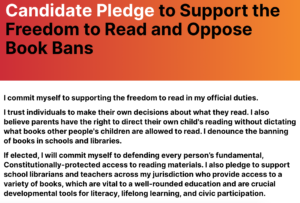 Screenshot of Candidate Pledge from the Unite Against Book Bans pledge page. (Unite Against Book Bans)
A fundamental aspect of the ALA is to challenge censorship and “defend intellectual freedom in libraries” by supplying resources and workshops to help defend library resources to the librarians (ALA). They also compile a ‘Top 10 Most Challenged Books’ which is updated each year and trend reports for the public awareness (ALA). A huge contributing factor in compiling these statistics comes from public input and they have a section of their website set up to report censorship to “defend the public’s freedoms” (ALA).
Censorship comes in many forms and usually proceeds from a cultural, religious or political opposition to the content. Often throughout history, it has been in an attempt to control culture, consolidate power or to remove comparisons to past events/figures.
“Who controls the past controls the future. Who controls the present controls the past.” – George Orwell, 1984.
One of the most notorious occasions for book censorship is the book burning by the Nazi regime. In a symbolic act, “university students burned upwards of 25,000 volumes of ‘un-German’ books, presaging an era of state censorship and control of culture”[9]. Included in the burnings were works by prominent literary and political figures with the Nazi regime continuing the acts of censorship by “raiding bookstores, libraries and publishers’ warehouses to confiscate materials that were deemed dangerous or ‘un-German’” (Holocaust Encyclopedia). This act enforced the Nazi desire to control culture by eradicating (censoring) that which it deemed degenerate and detrimental to the vision of Germany the Nazi’s held.
Another historical account of censorship and public book burning was in 213 B.C. when the Chinese emperor Qin Shi Huang (commonly remembered for his Terracotta army in Xian) targeted books of poetry, philosophy and history to take them under “governmental control” and had a great many books burned to consolidate power and avoid comparison to more virtuous and/or successful rulers of the past[10]. More recently within Chinese history, Mao Zedong destroyed books which didn’t confirm to the party propaganda during the Cultural Revolution including works which promoted capitalism or other ideas deemed dangerous – something seen today in North Korea which operates a similar mandate for censorship (Boissoneault).
These examples highlight the significance that censorship by the burning of books has on a culture, and how much and how easily erasure and modification can happen to the histories. In 2012, al-Qaida Islamists targeted priceless manuscripts including medieval works. In Poland a priest led a public burning of books in Gdansk that were deemed as evil[11], and in 2022 a Conservative pastor in Tennessee burnt books which were deemed occult or a “threat to their religious rights and freedoms and belief systems”[12]. The same article goes on to mention how Conservative states across the US were leading widespread efforts to limit the teaching and education of themes such as racism and the Holocaust with hundreds of titles being from shelves in Texas that “might make students feel discomfort, guilt, anguish, or any other form of psychological distress because of their race or sex” (Marcus).
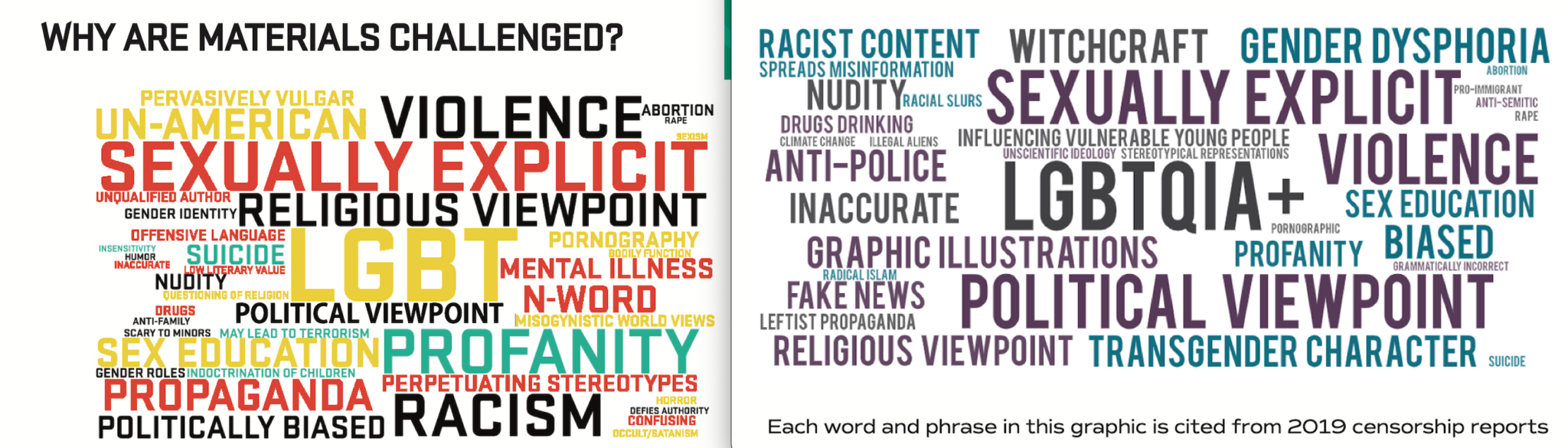 Screenshot of two word clouds from ALA infographics showing the words for censorship that are trending. Left is from 2017, right is from 2019 (ALA).
While the ALA has its primary focus within America, it is worth noting the findings of their research over the years. The above word cloud graphics come from a compilation of infographic posters compiled each year by the ALA. Included in the 2017 one is the term “Un-American” – which mirrors the Nazi censorship thought of materials that were deemed “un-German”. Also included in the 2017 graphic is “Politically Biased” and “Political Viewpoint”. These terms of censorship were trending just after the inauguration of Donald Trump – continuing the pattern of censorship being a part of a new authorative/ruling figure to a country/state.
If the use of political language (as demonstrated by Orwell in his essay ‘Politics the English Language’, and the terms which can be seen in the word cloud trends provided by ALA) can be used to cajole public opinion into believing that important histories (such as that of the Holocaust) or literary works which incite thought and reaction (such as dystopian fiction) are dangerous in some way, and those works are then censored and removed from libraries and academic institutes, then it is not much of a leap to presume that those who fail to learn from history are doomed to repeat it.
Returning to the first quote “Books Unite Us, Censorship Divides Us”, the clearest example in the modern world of how the censorship and denying access to knowledge can create division can be witnessed in the modern-day divide between North and South Korea. All though the current divide between the North and South was a result of the Soviet Union and the United States occupation in Korea at the culmination of World War II 70 years ago, the political divide initiated by the original Soviet communist policies and the US anti-communist policies which led to the development of the divided governments is apparent in today’s politics between the capitalist south and the communist north.
“Art not related with the revolution, art for its own sake, is useless.” – Kim Jong Un.
While South Korea enjoys unlimited and unfiltered access to knowledge, North Korea has become referred to as the hermit state by many owing to its extreme censorship of media which is propagated by the government. This extreme censorship of North Korea has become a regular talking point of the internet over propaganda balloons being sent both ways by the neighbouring countries – a topic which in itself is too expansive to discuss here.
However, it is still worth remembering North Korea admits that art and culture are “an explicit part of an elaborate propaganda system that answers to the Worker’s Party”[13], with the production being overseen by North Korean Artist’s Federation to ensure it “fulfils the ideological, political and social mission and upholds the party line” (Bonner). All though this primarily applies to art rather than the literary world, this application of propagandic thought goes throughout the entire North Korean culture – including literary works – with the belief that the Leader is the guarantor and protector of the people, and that “they are blessed with a carefree existence under the wise rule of the benevolent Leader” (Bonner).
Information about life in North Korea which hasn’t been propagated by Kim Jong Un and the Worker’s Party has been smuggled out. One such example is the book The Accusation Forbidden Stories From Inside North Korea written by an author known as Bandi. The manuscript was smuggled out by South Korean activist Do Hee-youn who said this to the CNN: “It doesn’t deal with political prison camps, or public executions, human rights issues. It shows normal life of North Korean citizens and it is very frightening. This book shows that they live like slaves”[14]. The book is considered fiction, but as discussed previously, fiction will still reflect the truth of something – which in this specific case is the short stories written by a citizen that show a different reality to that of a “carefree existence” and that there is “Nothing to Envy” (Bonner).
What is also fascinating with this situation is that the manuscript was smuggled out of North Korea between the propaganda books on the former leaders Kim Il Sung and Kim Jong Il (Hancocks). This is paradoxical to Kim Jong Un’s words “Revolutionary art awakens people to the truth of struggle and life and inculcates in them rich emotion and verve” in that, while he as the Leader is working with the Worker’s Party to create an illusion through propagandic works, those works themselves are being used as part of a different revolution.[15]
Having discussed some of the different forms of censorship throughout history and within dystopian and speculative fiction, it should be clear now just how important it is for everyone to have access to knowledge in any format. As exampled by North Korea, Kim Jong-Un’s methods of forbidding adolescents in particular to any type of literature which he doesn’t consider important or relevant to his revolution, the result to the youth or North Korea is that they grow up all thinking the same, without any hope or aspiration for change[16]. This same message is shown throughout the fictitious works by George Orwell in 1984 and in The Hunger Games by Suzanne Collins amongst others.
The factual accounts of the world and its histories alongside fiction which can speculate the effect of these themes upon society serve to warn the future against the mistakes of the past – and most importantly of all, it continually reiterates the importance of knowledge (however it is stored and presented e.g., books) how severe the consequences of censorship and the proceeding erasure can be to a society and its culture.
This is also why the campaigning and activism by associations such as the ALA are vital. It is why intellectual freedom in libraries needs to be defended, and why access to information should always be accessible to all.
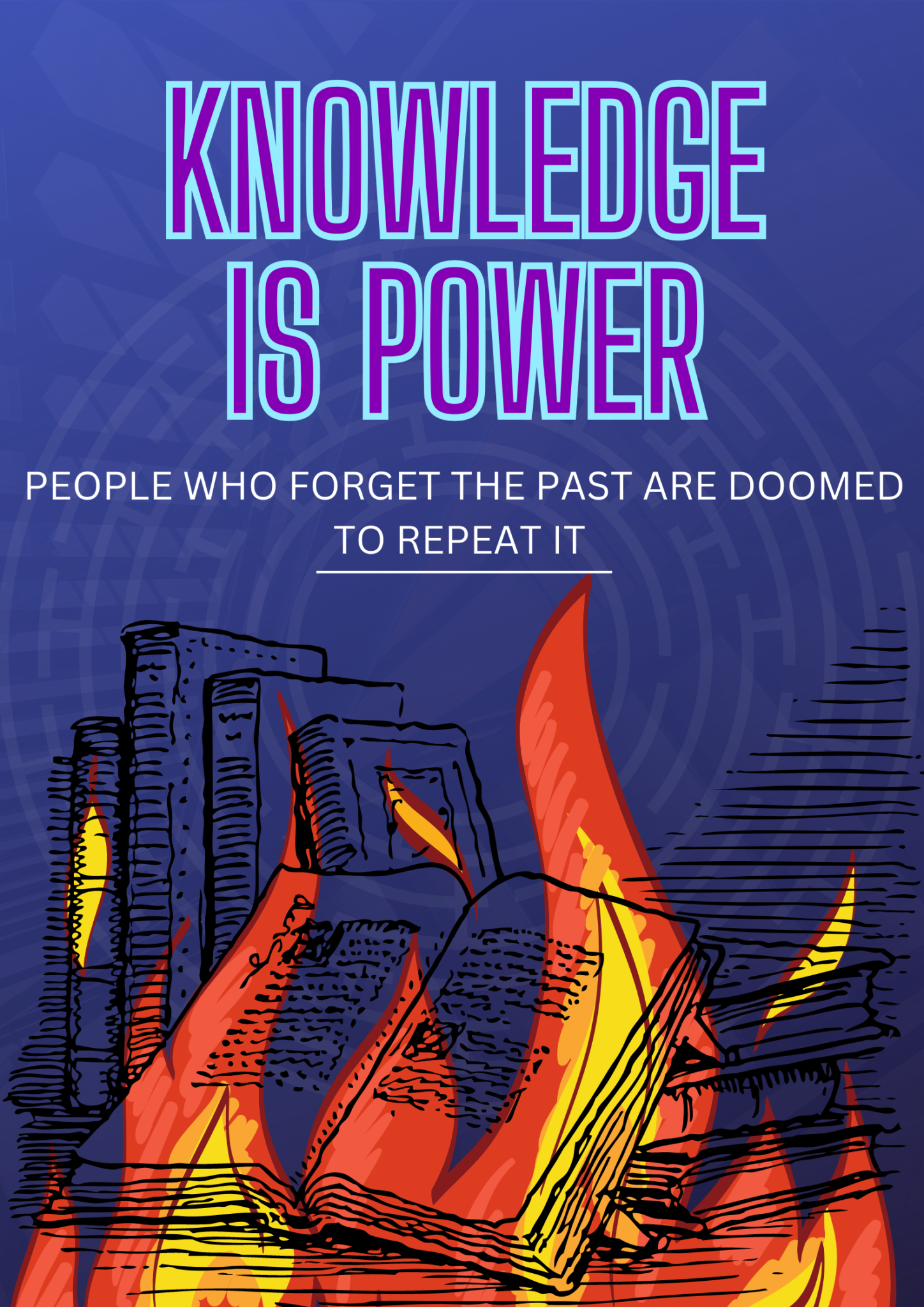
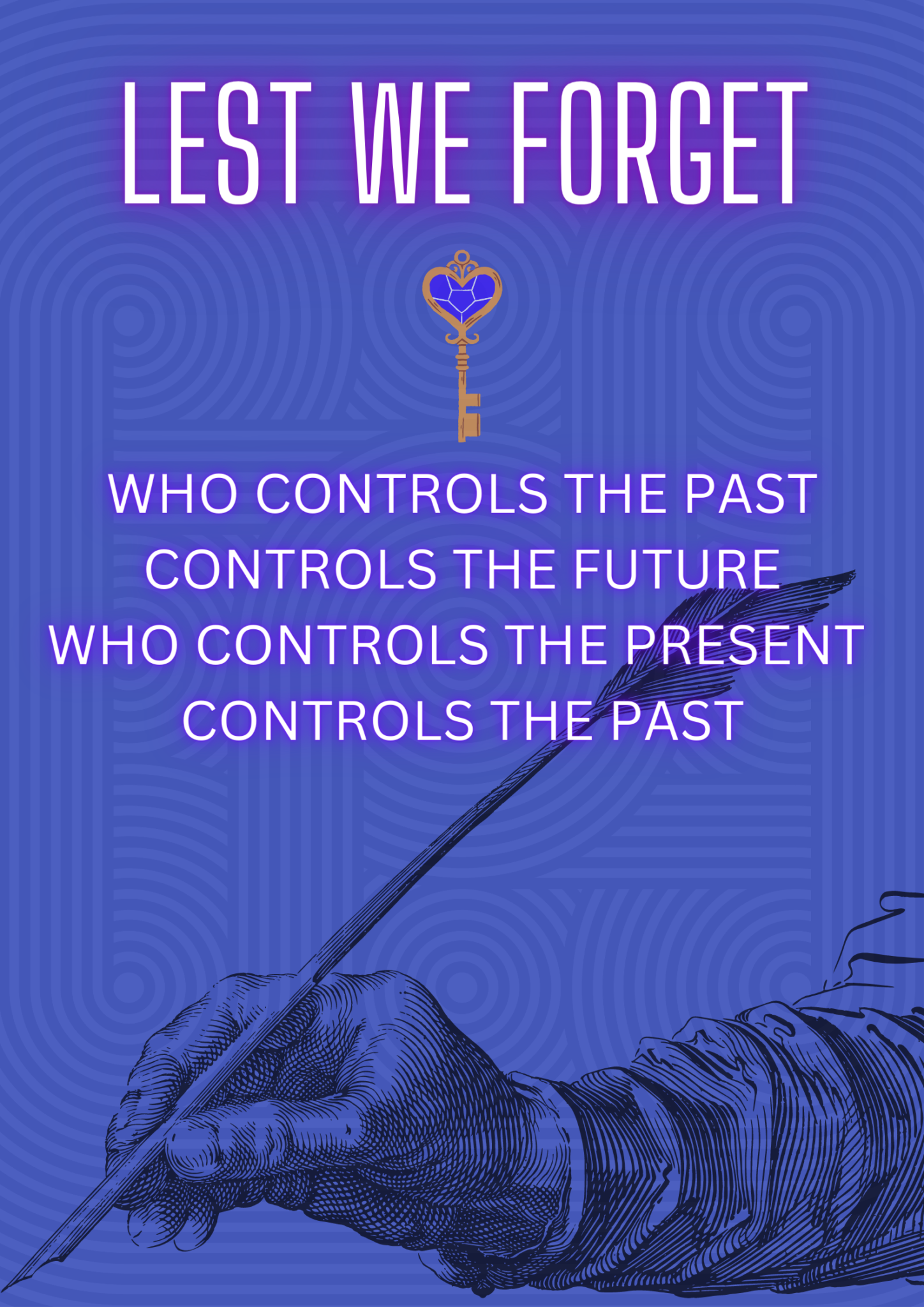
Posters designed as part of the assignments:
[1]American Library Association, Banned Books Week, (2022), <https://www.ala.org/advocacy/bbooks/banned/> [accessed: 5thMarch 2023]. Subsequent references to this source are given in the text as (ALA).
[2] Unite Against Books Bans, Constitutional Pledge Page, (2023), <https://uniteagainstbookbans.org/>, [accessed 13th March 2023]. Subsequent references to this source are given in the text as (Unite Against Book Bans).
[3] ALA Store, Banned Books: Defending Our Freedom to Read, <https://www.alastore.ala.org/content/banned-books-defending-our-freedom-read/>, [accessed 13th March 2023].
[4] Lianne Kolirin, Changes to Roald Dahl’s classic children’s books spark censorship spat, (2023), <https://edition.cnn.com/style/amp/roald-dahl-censored-gbr-scli-intl/index.html/>, [accessed 11th March 2023].
[5] George Orwell, 1984, (London: Penguin Classics, 2000).
[6] George Orwell, ‘Politics and the English Language’, in Why I Write, London: Penguin Books, 2004), pp. 102-119 (P.110).
[7] Butler University, Banned Books: Commonly Banned Books, (2021) <https://libguides.butler.edu/c.php?g=34189&p=217684/>, [accessed 13th March 2023]. Subsequent references to this source are given in the text as (Butler University).
[8] Calvert W Jones and Celia Paris, How Does Fiction Shape Politics And What Can We Learn from Analysing Its Impact on Public Attitudes?, (2018), <https://www.allianceforpeacebuilding.org/research-talks-blog/how-does-fiction-shape-politics-7-2022/>, [accessed 12th March 2023].
[9] United States Holocaust Memorial Museum, Book Burning, <https://encyclopedia.ushmm.org/content/en/article/book-burning/>, [accessed 5th March 2023]. Subsequent references to this source are given in the text as (Holocaust Encyclopedia).
[10] Lorraine Boissoneault, A Brief History of Book Burning, From the Printing Press to Internet Archives, (2017), <https://www.smithsonianmag.com/history/brief-history-book-burning-printing-press-internet-archives-180964697/>, [accessed 5thMarch 2023]. Subsequent references to this source are given in the text as (Boissoneault).
[11] BBC, Harry Potter books burned by Polish priests alarmed by magic, (2019), <https://www.bbc.co.uk/news/world-europe-47771706/>, [accessed 13th March 2023].
[12] Josh Marcus, Conservative pastor holds ‘witchcraft’ book burning event targeting Harry Potter and Twilight, (2022), <https://www.independent.co.uk/news/world/americas/book-burning-tennessee-harry-potter-b2007904.html/>, [accessed 5thMarch 2023]. Subsequent references to this source are given in the text as (Marcus).
[13] Nicholas Bonner, Printed in North Korea The Art of Everyday Life in the DPRK, Phaidon Press, (2019), P. 9. Subsequent references to this source are given in the text as (Bonner).
[14] Paula Hancocks, Stranger than fiction: How forbidden book was smuggled out of N. Korea, (2017), <https://edition.cnn.com/2017/04/02/asia/north-korea-the-accusation/index.html/>, [accessed: 15th March 2023]. Subsequent references to this source are given in the text as (Hancocks).
[15] Bonner, Printed in North Korea, p.130.
[16] delp.25, North Korean Censorship of Literature and How it Affects Children, (2018), <https://u.osu.edu/yaliteraryglobetrotters/2018/11/30/north-korean-censorship-of-literature-and-how-it-affects-children//>, [accessed 15th March 2023].